
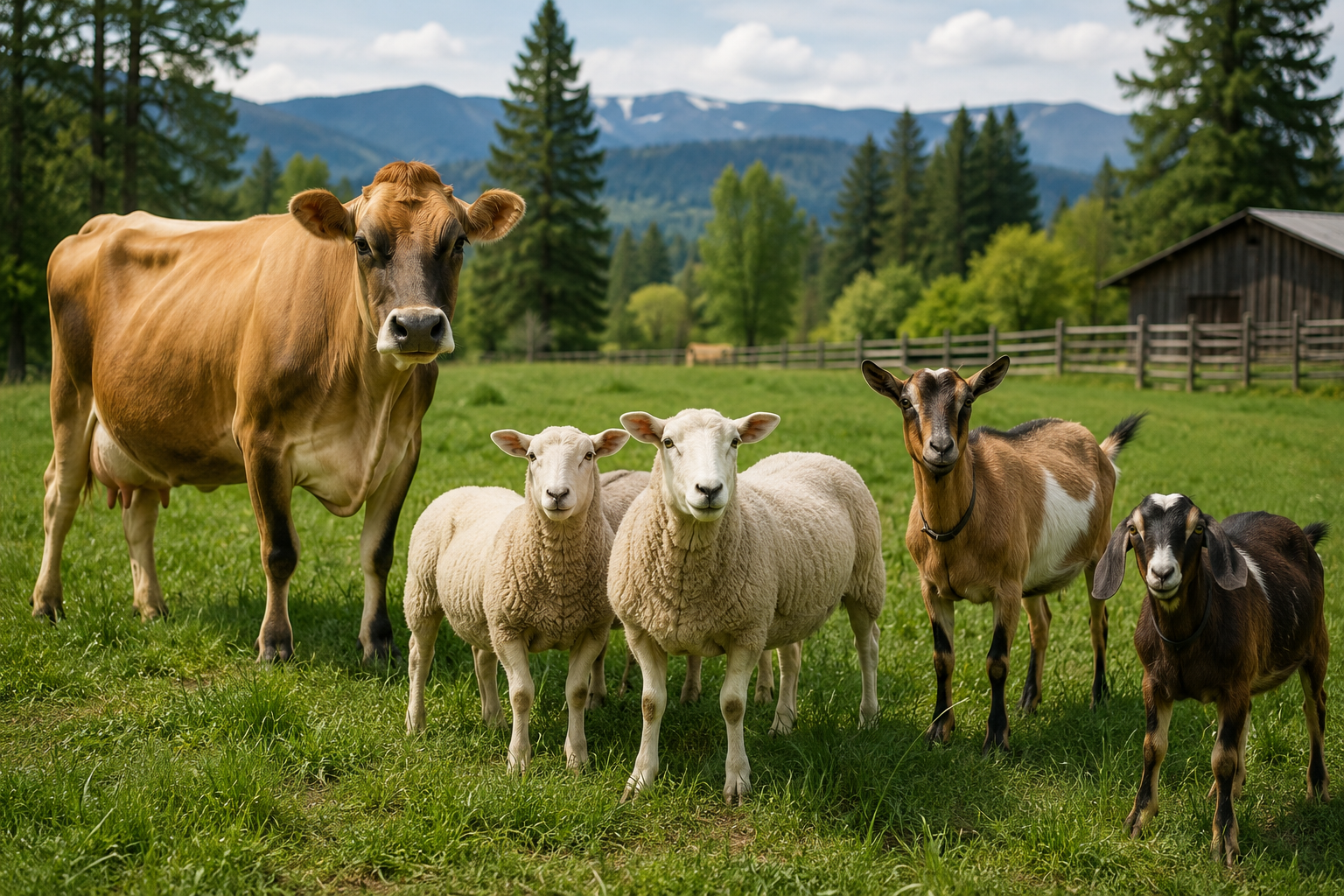
Choosing the right dairy animal for a homestead isn’t as straightforward as most people expect. Goats, sheep, and cows all have their strengths—and their challenges—and the “best” choice depends heavily on your goals, your setup, and your tolerance for the realities of daily farm life.
There is no single right answer. In some cases—like ours—you may even choose more than one species. For those in the decision-making phase, or reconsidering earlier choices, I want to share what I’ve learned from raising and milking goats, sheep, and cows in both homestead and small dairy settings.
About My Experience
My experience with goats spans about fifteen years and includes Nubian, Oberhasli, Boer-dairy crosses, and a Nigerian-Oberhasli cross, with most of my time spent working with Oberhasli.
For sheep, I’ve focused on East Friesian dairy sheep, striving for as high of percentage as possible, while also crossing with meat breeds for lambs destined for the freezer.
With cattle, I started as a relief milker in high school for a Shorthorn dairy. Since then, I’ve owned and milked Brown Swiss, Swedish Reds, Jerseys, and various dairy crosses. At times I’ve sold raw milk with the required state permit, and at others I’ve milked solely for personal use.
The main considerations I’ll cover are housing, feeding, waste, breeding, milk production, offspring, and risk.
Housing & Fencing
All dairy animals require shelter from the elements—shade in the summer and protection from wind, rain, and cold in the winter. Dairy animals, especially their young, tend to be less hardy than meat breeds. That makes sense, as they’ve been selectively bred for milk production and historically lived in closer daily interaction with people.
Fencing needs vary.
All species do well with electrified fence. Panel fencing often fails to contain kids and lambs. Goats are by far the most likely to challenge fences—they are the most curious and persistent escape artists. Cattle, on the other hand, bring more force when they test a fence, so infrastructure needs to be sturdier.
All species will rub on fencing if it isn’t electrified, which leads to long-term wear and failure.
Feeding
Feeding requirements overlap, but they are not interchangeable.
Goats and cattle require significantly more copper than sheep. Sheep need relatively low levels and can develop copper toxicity if over-supplemented. This is manageable with attention but cannot be ignored.
Hay quality also matters. Sheep and goats tend to do better with finer hay—second or third cutting—to reduce waste. Cattle are more efficient at utilizing coarser first cutting hay, which is typically more affordable.
Feeding systems are another major difference.
Cattle feeders are far more effective at reducing waste. We can almost entirely elminate waste when feeding cattle with feeders. With goats and sheep, unless feeders are very well designed, kids—and to a lesser extent lambs—will climb into feeders, soil the feed, and increase waste.
Waste
Cow manure is the most difficult to manage in my experience. It is liquid to semi-liquid and accumulates in piles.
Sheep and goats produce firm pellets that settle more easily into bedding. If animals lie in soiled areas—and they will if allowed—the difference becomes very noticeable.
It also often feels like one cow produces more waste than their “equivalent” five or so small ruminants combined, though part of that is simply the form and visibility of the waste.
Breeding
Breeding is one of the most overlooked aspects when choosing a dairy animal. To get milk, you must breed your animals—and that means dealing with males.
Bulls are a serious consideration. While I’ve kept good ones, they were beef bulls. Dairy bulls—especially Jerseys—are widely known to be unpredictable and aggressive. I do not recommend them for homesteads or small dairies.
Artificial insemination (AI) is safer and often more economical over time. With cattle, AI is widely available, and sexed semen allows you to strongly favor heifer calves. Estrus synchronization can make breeding more predictable and easier to schedule, especially with multiple animals.
Goats can also be bred using AI, with techniques similar to cattle on a smaller scale.
Sheep are different. AI in sheep requires a surgical laparoscopic procedure due to low success rates with cervical methods. This often involves a veterinarian or specially trained AI tech and added cost.
Keeping males is an option for small ruminants, but each has tradeoffs.
All males like to fight – they need to protect their position as the breeding dominant male and show fitness to the females. They also need to protect their herd or flock. This isn’t something that can be reasonably trained out of them. Rams may fight and can develop aggressive tendencies. I have had a couple of rams that wanted to be aggressive to humans, and both were percentage Lacaune. I’m not sure if that was the cause, though I’ve found East Friesian rams to be relatively manageable.
Bucks can also be aggressive, but the biggest drawback is odor during rut. Their musk production kicks into high gear and they urinate on themselves, which the females find very attractive. They are the only ones with this reaction. It is intense, very strong, carries far, and will rub off on clothes and skin even with light handling.
Of the two, I find rams easier overall.
Another important point: males should not be fed the same calcium-rich diet as lactating females. Small ruminants are particularly prone to urinary calculi, which can be fatal.
Milk Production
Milk production varies widely between species.
A single Jersey cow may produce 3–5 or more gallons per day, with relatively high butterfat among dairy cattle. Goats typically produce between half a gallon and a gallon per day, with milk higher in protein and fat compared to cow milk. Sheep produce the smallest volume—often just over half a gallon per day—but have the highest fat and protein content. East Friesian dairy sheep tend to produce more than many other sheep breeds. A good producing ewe will out-produce a moderate producing doe.
Each type of milk has a distinct flavor. Some people cannot tell the difference, but many can. Sheep milk is the mildest and creamiest to me. Goat milk has a slight tang, and cow milk is the most familiar—though store-bought milk often carries the flavor of processing and packaging.
All three have their place.
For cheesemaking, sheep and cow milk offer greater versatility, particularly for aged cheeses. Goat milk excels in soft cheeses but is more limited in my experience. I really love aged and hard cheeses, so this is was a critical detail when I selected which dairy animals to keep.
Digestibility is another major factor for many people.
A2A2 cow milk is easier to digest than conventional milk containing the A1 protein mutation. Sheep and goat milk are naturally A2A2. Some individuals tolerate one species better than another wether for ability to digest, allergies, or taste preference.
If improving body condition for a family member is a goal of home milk production, sheep milk would be my top choice due to its density and richness.
Scalability also differs.
With goats and sheep, you can adjust production more gradually. A cow represents a larger step change in milk supply. Roughly speaking, one cow equals about five high-producing goats or seven purebred East Friesian sheep.
Offspring & Meat
All dairy animals produce offspring, and that is part of home dairying. Cows typically have single calves, while goats and sheep often have twins. This means small ruminant populations can expand much more quickly.
If a mother loses her offspring, you take on the full responsibility of maintaining her milk production through regular milking. A twin can help keep her in milk so this provides more flexibility how obligated your are to milk on a schedule.
From a meat perspective, small ruminants reach processing age much sooner—typically 8–10 months—while dairy cattle or crosses often require 22–24 months.
Handling and processing are also easier with smaller animals.
I eat lamb, beef, and previously ate goat (when I owned them). Properly raised and handled, none of them are inherently “gamey.” I eat as much lamb as beef today. I was raised without eating lamb and taught it “would peel the wallpaper off the walls to cook it.” That’s just not true. Lamb is excellent and a very overlooked and underappreciated meat source. It is also not be confused with mutton (from sheep older than a year). If considering sheep and unsure about meat production, I encourage you to try some professionally prepared in restaurants you like. Give it a few tries. I also have some lamb recipes includes in this website, but be aware that much of the lamb in supermarkets is old and mutton.
In my experience, dairy sheep outperform dairy goats in both the quantity and quality of meat. All of my lambs produce heavier, better muscled carcasses than any of my dairy goats or dairy-meat crosses. If meat production is a priority alongside milk, sheep are my preferred choice.
For cattle and goats, crossing with a meat breed can significantly improve carcass quality. I’ve found this unnecessary with sheep though I have experimented with Suffolk-Texel terminal sire.
Additional Considerations
Horns are worth considering.
I’ve kept horned animals in the past – horned goats and cows. They pose safety risks for humans and other animals without even meaning to be rough, especially the cattle. The goats often become entangled or caught up in anything they can find – this can be impressive at how good they are at getting caught. Disbudding, while not pleasant, simplifies management significantly and isn’t really that bad to do. I now consider it an unquestioned standard of care for my livestock. East Friesian sheep are naturally polled (hornless), while Jerseys and goats are almost always horned though may rarely be polled.
Size is another major factor.
When working in urgent care, I’ve had people come in with broken hands, legs, and once a dislocated shoulder from cattle. I can’t remember a single sheep or goat injury. I’m sure it happens … maybe it’s so severe they just go straight to the ER. Not really. Having a stressed, injured, aggressive, or careless animal that is 1,000 pounds versus 150 pounds can end every differently for you, your children, or guests to your homestead.
That difference matters.
Final Thoughts
There is no single “best” dairy animal—only the one that best fits your family, your land, and your goals.
Choosing well can mean the difference between a frustrating experience and a deeply rewarding part of your homestead—one that provides not only fresh milk, but a deeper connection to your animals and your land.
I welcome thoughtful questions and shared experiences in the comments. If you’ve worked with dairy animals, your perspective may help others making similar decisions.
Please keep comments respectful, relevant, and constructive so this can remain a useful resource for everyone.